Over nine days this fall, Denver issued full-demolition permits for six addresses in the Wash Park area. The first, on Oct. 26, was on South Race Street. Next came South Columbine Street in Cory-Merrill on Oct. 27, then two on Oct. 28, one on South Gilpin Street and one on South Clarkson Street in Platt Park. On Nov. 3 the city issued two more, on South Gilpin and on South Emerson Street.
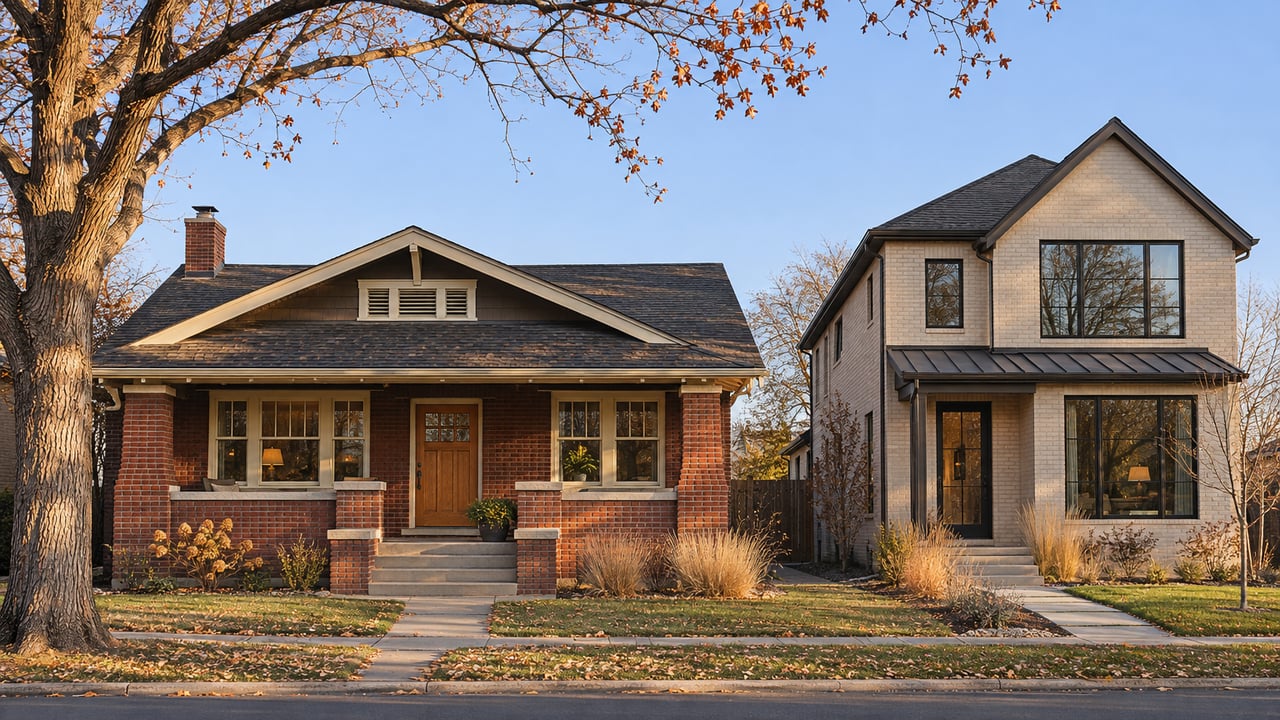
In Washington Park, West Wash Park, Platt Park and Cory-Merrill, a teardown is a routine event, and that changes what you're buying when you shop here. Every original house sits on a lot that someone could value more than the house itself. When neighbors try to save a building, the effort tends to change the terms of its sale more than its future. So whether you want the 1920s bungalow or the new build that replaced the one next door, the price of the lot is part of what you pay.
One in Five Denver Teardowns Happens in These Four Neighborhoods
Denver's Tear-Down Tracker is built from the city's own demolition permit records. Between Nov. 3, 2025, and Nov. 3, 2026, it counts 482 full-demolition permits citywide. Washington Park had 45 of them, more than any other Denver neighborhood and nearly one in ten for the whole city. Platt Park had 20 in the same twelve months, Washington Park West had 19 and Cory-Merrill had 17. That puts 101 of Denver's 482 full demolitions over that period, about 21%, in four neighborhoods that sit side by side.
The neighbors fill in the rest of the map. University Park had 24 full-demolition permits over the same twelve months and Belcaro had 20. Berkeley, second on the list with 27, is the only neighborhood outside south-central Denver that comes close to Washington Park.
The longer record shows this isn't a one-year spike. From 2016 through Nov. 3, 2026, Washington Park had 448 full-demolition permits, the most of any Denver neighborhood. Cory-Merrill had 240, Platt Park 237 and Washington Park West 181. Together that comes to 1,106 permits. Citywide, the tracker's yearly counts over the same stretch add up to 6,770, so roughly one in six Denver teardowns of the past decade happened in these four neighborhoods.
The citywide pace is lower than it was. Denver issued 768 full-demolition permits in 2016 and 458 in 2025, and 2026 stood at 411 through Nov. 3, with nearly two months still to count. A smaller citywide total still left Washington Park at the top of the neighborhood list, so the slowdown has come from other parts of the city first.
The Lot Is Part of Every Original House's Price
Here is what that concentration means for someone touring an original house in Platt Park or on a Wash Park side street. Each full demolition marks a property whose owner decided the lot was worth more without the building on it, and these four neighborhoods have logged more than 1,100 full-demolition permits since 2016. In our view, a buyer here should expect that an older home on a standard lot can appeal both to people who want to live in it and to people who want to replace it. With both of those buyers possible, a dated original house has a price floor that has little to do with its kitchen.
Scrape math is old here, and an example from more than a decade ago shows the basic outline. In 2015, Jackson Design Build wrote that it had paid $460,000 for a 1,760-square-foot 1921 duplex in West Wash Park, torn it down and marketed the two replacement homes at $889,000 each. Those 2015 prices are long outdated. The structure of the deal still holds: a builder's offer on an old house is worked backward from what the new house will sell for.
The same logic applies to buildings people might assume are protected. At 400 S. Williams St., the annex of Washington Park United Church of Christ was demolished in 2026 to make way for a single-family home on the property's southern lots. Even church land on a residential block here ends up as a site for a house.
For a buyer of an original home, the practical takeaway is that waiting for a dated house to get cheap rarely pays in these four neighborhoods. A house that needs everything still has a lot under it, and that lot has value even if the house needs a full renovation. Our earlier guide on competing as a buyer in Washington Park and Platt Park covers how to write offers. The teardown numbers explain why an original house here can draw competition that has nothing to do with its condition.
Two Addresses Where Neighbors Pushed Back
Preservation efforts do happen here, and the two most visible recent ones show how they tend to end.
The first is 800 S. Franklin St., a house built in 1890 across the street from Washington Park. BusinessDen reported in July 2025 that the house was facing demolition for the second time in four years. City records show a demolition application in January 2021 that was withdrawn under an agreement with the city. The property sold in February 2025, and the new owner filed a new demolition application on May 19, 2025. Residents filed for landmark designation. At the Landmark Preservation Commission's Sept. 16, 2025 meeting, the motion to recommend designation tied 3 to 3, and so did a separate motion to deny it. Neither passed, and the matter never went to City Council.
The second is the church at 400 S. Williams St. City staff found the building potentially eligible for landmark designation. A 2025 demolition application for the church was withdrawn on July 24, 2025, and the owner agreed to look for a buyer interested in preserving it. On July 17, 2026, a new application for total demolition was filed. Neighbors filed a notice of intent to seek designation on Aug. 24, and mediation meetings followed on Sept. 10 and Sept. 23.
The owner and the neighbors then asked for more time to work out a good-neighbor agreement tied to a future sale of the church, and the neighbors planned to document the building for future research. On Sept. 30 the commission voted 6 to 2 to extend the review period to Nov. 17, 2026. The current status is on the city's demolition posting page.
Look at where each case ended up. On Franklin, it was a tie vote that settled nothing. On Williams, it was extra time to negotiate over a future sale. Both were serious efforts that took months of neighbors' time. Neither is a reason to assume an original house in these neighborhoods is safe from a builder's offer.
Reading the Block Before You Buy
If you're shopping for an original house, expect the builder floor to be part of the asking price. Compare the house against recent sales of similar lots nearby, not against how much work it needs. Condition matters less here than it would in a neighborhood where builders aren't buying.
If you're shopping for a new build, look at the houses on either side of it. The permit record shows that this part of Denver keeps getting rebuilt one lot at a time. The original bungalow next door to a finished new home is the kind of house that shows up as a permit. Living next to a construction site for a stretch is a realistic possibility on many of these blocks, and it's worth weighing before you choose which house to bid on.
If you already own an original house here, the builder's interest is part of your home's value whether or not you ever sell to one. A home valuation that accounts for land value will look different from one that only compares finishes. Our Washington Park neighborhood page and our earlier look at how Old South Gaylord and Old South Pearl are changing fill in the neighborhood around these numbers.
Quick Answers
Is the teardown pace in Denver slowing? Citywide, yes, compared with the peak. Denver issued 768 full-demolition permits in 2016, 458 in 2025 and 411 in 2026 through Nov. 3. Washington Park still led every Denver neighborhood for the twelve months ending Nov. 3, 2026.
Do these counts include only houses? No. The tracker counts every full-demolition permit the city issues, whatever the building. The church annex at 400 S. Williams St. is one example of a non-house demolition in the area.
Where can I see demolition permits near a house I'm considering? Denver publishes a Demolition Permits dataset on its open data catalog. It lists each permit's issue date, permit class and neighborhood.
If you're deciding between an original Wash Park house and a new build down the street, Eric and Karla are happy to talk through the specific blocks you're considering and what the teardown pattern there means for your offer. Reach out to The Tack Group whenever you're ready. Work with The Tack Group.